
Red Light Therapy
A Red Light Routine to Support Healthy-Looking Skin
5D Wellness Team·12 min read·October 13, 2026
It's mid-October in East Bethel, the afternoons are already giving up around five, and if you've lived through a few Minnesota winters you know what's coming for your skin. Forced-air heat from Halloween to Easter. A windchill walk across the Cub parking lot. Hot showers, because the alternative is unthinkable. By February the face in the bathroom mirror looks tight, dull and tired of the whole thing.
Which is why a red light therapy routine for skin is worth understanding now rather than in March. The important word is routine. This isn't a one-time facial you book before a wedding. Nearly all the research on red light and skin is really research about cadence — short sessions, a couple of times a week, held steady for months. Harvard Health puts it bluntly: "It's slow and steady. It's not going to be anyone's quick fix."
What Red Light Therapy Actually Is
You'll see it called red light therapy, photobiomodulation, low-level light therapy, sometimes cold laser therapy. Cleveland Clinic groups them together — they all describe specific wavelengths of visible red light delivered to the skin at low intensity.
The mechanism comes down to cellular energy. Red light is absorbed by mitochondria, which Cleveland Clinic calls "the 'power plant' in your body's cells." That light switches on an enzyme called cytochrome c oxidase, which in turn increases mitochondrial production of ATP. More available energy, more capacity for cells to do their ordinary maintenance work. In skin, red light reaching the dermis is associated with stimulating fibroblasts — the cells that produce collagen and elastin.
What it isn't matters just as much. Red light is not ultraviolet. It's not a tanning bed, and it isn't the cancer-causing kind of light. It's also no substitute for the boring fundamentals; Harvard frames it as something that works alongside sun protection, sleep and regular moisturizing.
One honest caveat before we go further. Cleveland Clinic notes that many published studies were small, lacked placebo groups, or tested only animal models, and that most researchers call the results promising while asking for larger human trials. Everything below is supportive wellness, not medicine.
Why a Minnesota Winter Is the Natural Time to Start
From late October through March, skin across Anoka County takes a sustained beating — dry indoor air, sixty-degree swings between your living room and your driveway, barely any daylight. That same stretch happens to be when a 20-minute indoor appointment sounds genuinely appealing. Nobody in Ham Lake wants an extra errand in July. In January, a warm quiet room with a panel of red light is a pleasant place to spend a few minutes.
And because this practice rewards consistency over intensity, timing matters. Start in mid-October and you hit the three-month mark in late January, right when the heated air has done its worst. Most of the North Metro is a short drive to East Bethel — ten to fifteen minutes from Cedar or Oak Grove, twenty to twenty-five from Andover, Blaine, St. Francis or Isanti. Twice a week from there is a manageable ask.
What a Session Actually Looks Like
Before. Come in with clean, makeup-free skin. Anything on the surface sits between you and the light, so Cleveland Clinic's LED guidance is to arrive with a bare face. Eye shields go on next. Harvard's instruction is direct: keep the light out of your eyes, and if shields are provided, use them.
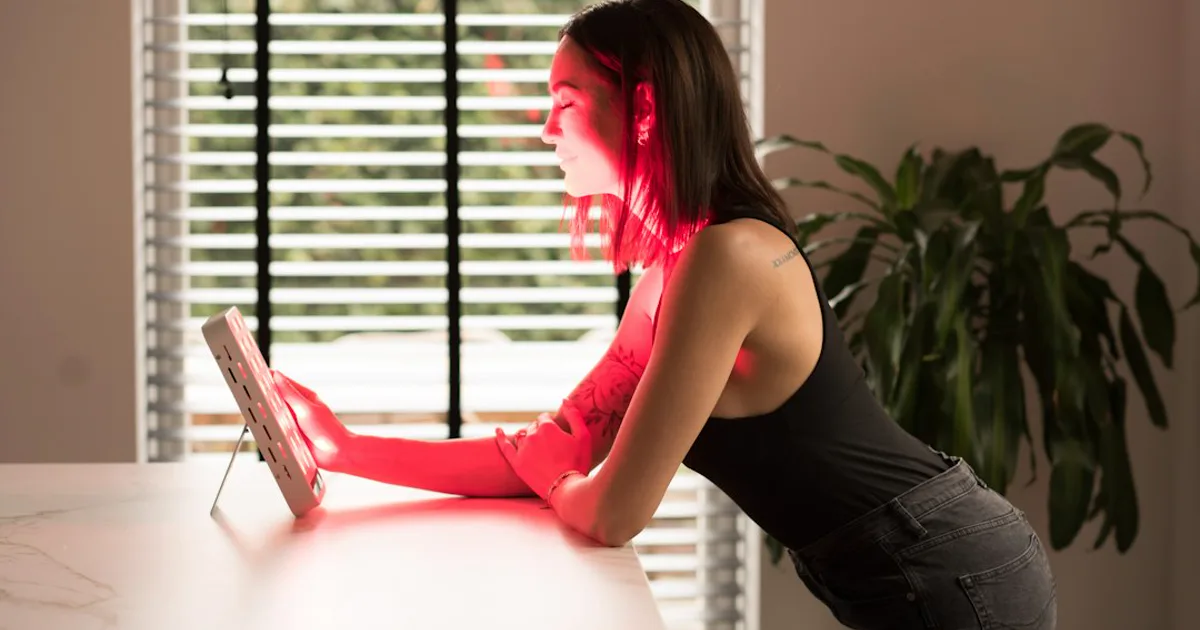
During. You lie back and the panel is positioned above you. An in-office LED session typically runs about 20 minutes, while the protocols used in skin studies often involve just 10 to 12 minutes of real exposure. It's painless. Mild warmth is about the extent of it — no needles, no peeling, no numbing cream. For a look at the room and the panel we use, here's red light therapy at 5D Wellness.
After. Essentially no downtime; you can head straight to work or to pickup. Extra sunscreen and a few days of sun caution are advised, which still applies in a Minnesota winter when snow glare is doing real work. Mild temporary redness is the common side effect — one review of red light devices notes increased local blood flow can continue for up to 30 minutes afterward.
Building the Routine: Session Length and the Twice-a-Week Rhythm
Twice a week is the number to anchor on. It's the cadence most commonly used in skin research, and clinic guidance generally spans one to three sessions per week over weeks to months.
The spacing isn't arbitrary either. A three-month study using 630 nm light ran 12-minute sessions roughly 72 hours apart, deliberately, because the authors note "a few days are necessary for the photobiomodulation to be at its maximum efficiency." The cellular response builds over several days rather than on the spot. On a real calendar, a Tuesday-and-Friday or Monday-and-Thursday pattern lands that spacing without you having to think about it.
Red light also stacks easily with other short-session therapies, since it asks only for clean dry skin and leaves no recovery time — a cold plunge routine for morning energy covers the same scheduling problem. One last piece of arithmetic: twice a week for three months is about 26 visits, and that number usually decides whether drop-in pricing or a membership makes more sense.
Why the Numbers on the Panel Matter
Not all red light is equivalent, and the specs are where the difference lives. The most-studied bands are red at roughly 630-660 nm and near-infrared at roughly 830-850 nm. Red stays in the more superficial layers where fibroblasts live; near-infrared reaches deeper into tissue.
Intensity matters too. Studied ranges for skin applications run about 20-60 mW/cm² of irradiance with fluences between 4 and 18 J/cm². Irradiance is how bright the light is. Fluence is how much total energy you receive. As that device review puts it, hardware that doesn't disclose either number "may operate outside the therapeutic range" — meaning it may not be delivering a dose anyone has studied.
That's the practical case for a professional panel over a drugstore gadget: Harvard notes over-the-counter devices may be weaker and harder to evaluate, while professional versions are "likely to have the ability to better control the dose." We broke the comparison down in at-home masks compared to studio panels.
More Is Not Better: The Biphasic Dose Response
If you take one technical idea from this article, make it this one. Photobiomodulation follows what researchers call a biphasic dose response. Past a certain point, additional exposure produces "excessive ROS, NO, and the initiation of cytotoxic pathways" — so the benefit doesn't just plateau. It declines.
Translated into behavior: don't double up because you missed last Tuesday, don't sit under the panel for 40 minutes because 12 felt easy, and don't come four times a week to compress the timeline. Dose-dependent side effects are real at the high end, including redness and, rarely, blistering. The discipline that works here is unglamorous — show up twice a week for months, and don't try to win any single visit.
The Timeline: One Month, Two Months, Three Months
Honest numbers help here. In that three-month study of 20 adults aged 45 to 70, using 630 nm light for 12 minutes twice weekly, measurements were taken monthly:
- Month one: crow's-feet wrinkle depth down about 15.6%, firmness improved about 13.6%, dermal density up about 26.4%.
- Month two: wrinkle depth down about 34.7%, elasticity up about 17.1%, cheek roughness down about 18.2%.
- Month three: wrinkle depth down about 38.3%, firmness about 23.6%, dermal density about 47.7%.
Measured again 14 and 28 days after stopping, the results held steady with no significant change.
The caveats matter as much as the numbers. Twenty participants is a small study, and everyone in it kept using their normal skincare, which the authors acknowledge makes the device's independent contribution hard to isolate. Individual results vary. What's useful here is the shape of the curve: nothing visible in week one, modest change by month one, meaningful change by month three.
Who Should Check With a Provider First
This is a wellness practice, not a medical one, and a few situations call for a conversation with your healthcare provider or dermatologist first:
- You take a medication that increases light sensitivity — isotretinoin, lithium and certain antibiotics are the commonly cited examples.
- You have a light-sensitive condition such as lupus.
- You have a history of skin cancer or an inherited eye disease.
- You're pregnant, or managing any ongoing medical condition.
Skin tone is worth a note too. Harvard points out that people with darker skin may be more sensitive to visible red light and can develop dark spots, so "folks with darker skin types should start with lower doses." Start conservatively and build up. For a broader primer, what to know before your first red light visit covers the practical ground.
Frequently Asked Questions
How often should I do red light therapy for skin?
Most published skin research lands on roughly twice a week, and clinic guidance falls in the one-to-three-per-week range. One three-month study spaced sessions about 72 hours apart, because the cellular response takes a few days to peak. For a Minnesota winter, two visits a week fits around work, hockey practice and a driveway that needs plowing.
How long does a red light therapy session take?
Shorter than most people expect. In-office LED sessions typically run about 20 minutes, and the protocols used in skin studies are often just 10 to 12 minutes of actual exposure. Add a few minutes for makeup removal and eye shields and you're in and out — part of why red light slots easily into a visit that also includes a sauna or a plunge.
When will I notice a difference in my skin?
Think months, not days. In the three-month study of adults aged 45 to 70, wrinkle depth at the crow's feet dropped about 15% after one month and roughly 38% by month three. Harvard Health is direct: four to six months of consistent use, slow and steady. Individual results vary, and red light works alongside sun protection, sleep and moisturizing.
Is red light therapy safe for skin?
Red light is not an ultraviolet wavelength, so unlike sun exposure or a tanning bed it isn't the cancer-causing kind of light, and short-term use as directed is generally described as safe — mostly temporary redness. Long-term safety data is still limited. Use the eye shields, don't improvise longer sessions, and ask a healthcare provider first if you take light-sensitizing medication.
Can I just buy a mask instead of visiting a studio?
You can, and plenty of people in the North Metro do. The tradeoff is dose control: professional panels are generally better able to deliver a known dose, while consumer devices may be weaker and often don't publish the irradiance or fluence numbers that tell you whether they're in a studied range. Home masks also commonly run several hundred dollars or more.
Your Next Step
It comes down to one reframe: a red light routine is a cadence, not an event. Ten to twenty minutes under the panel, about twice a week, spaced a few days apart, held for months rather than weeks.
Two things most commonly derail it. People quit around week three because nothing has visibly changed yet, and people try to speed it up by going longer or more often. The timeline punishes the first mistake and the biphasic dose response punishes the second. Patience really is the active ingredient. Start now and you'll be three months in by late January, right when the dry indoor air and dark afternoons have done the most damage. Book a red light session and claim your Tuesday and Friday slots before the snow settles in for good.
This article is for general wellness and educational purposes only and is not medical advice. 5D Wellness services are not a substitute for professional medical care. Results vary by individual. Consult a qualified healthcare provider before starting any new wellness practice, especially if you are pregnant or have a medical condition.