
Red Light Therapy
At-Home Red Light Masks vs Studio Panels Compared
5D Wellness Team·11 min read·October 10, 2026
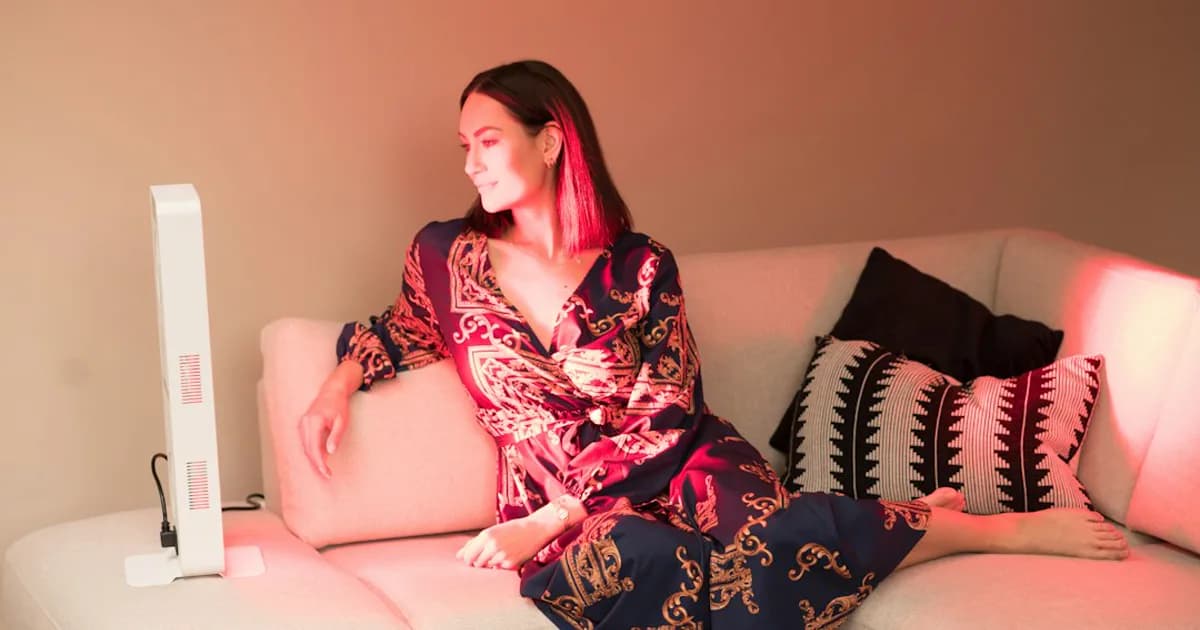
It's October in East Bethel. The sun's going down before dinner, and your feed is suddenly full of three-hundred-dollar LED face masks promising studio-grade light from your couch in twelve minutes. Which makes the question of at-home vs professional red light therapy more practical than philosophical. Hardly anyone argues anymore about whether red light does something — the mechanism research is reasonably settled. The argument is whether the device you can buy delivers what the panel you can book delivers.
It shows up every fall around here. Five months of short days and indoor training sends a lot of Ham Lake, Andover and Blaine neighbors shopping for one thing that helps their skin and their recovery at once. So: what the light is doing, what a mask covers, what a panel adds, why dose beats wattage, and which format you'll still be using in February.
How Red Light Actually Works
The clinical name is photobiomodulation, and the mechanism is less mysterious than the marketing. Certain wavelengths get absorbed by cytochrome c oxidase inside your mitochondria, which appears to raise cellular ATP production. Downstream, researchers see more collagen activity, better local circulation and less inflammation. Cleveland Clinic frames it the same way — stimulating mitochondria so cells have more energy available for skin repair and renewal.
Worth saying plainly: that's a supportive wellness effect, not medicine. Red light is something you add to a routine. It doesn't stand in for care from a provider.
Red and near-infrared do two different jobs
Here's the fact that settles most of the mask-versus-panel debate. The useful wavelength windows sit around 600–700 nm — visible red, which works at skin depth — and roughly 780–1100 nm, near-infrared, which reaches deeper into tissue. The stretch between 700 and 780 nm is comparatively ineffective, because it lands in a trough in cytochrome c oxidase's absorption spectrum. A review spanning published photobiomodulation studies describes red in the 600–660 nm range being aimed at the epidermis and shallow targets, with near-infrared pointed at deeper tissue.
So the format question is really a depth question. Skin goals — texture, fine lines, tone — need red. The shoulder you tweaked hauling the dock out wants near-infrared in the mix.
What an At-Home Mask Covers — and What It Doesn't
Masks have a genuine advantage, and it isn't power. It's distance and friction. The device sits directly against your face, so very little light is lost before it reaches skin, and it lives on your nightstand instead of nineteen minutes away. Research on a wearable facial mask running at 630 nm for twelve-minute sessions reported reduced wrinkles alongside more fibroblast, collagen and elastin activity. For face-level goals, that's a real result from a consumer-shaped device.
Three limits matter. The first is obvious once you say it out loud: coverage stops at your jawline. Nothing reaches your back, hips, hamstrings, or the knee that complains after hockey. The second is that in that same mask study, benefits faded within about a month of stopping — this is maintenance, not a one-time fix.
The third is the one nobody puts on the product page. Harvard Health notes that over-the-counter products may be weaker, and it's hard to know which device would be optimal to buy, at costs that typically run several hundred dollars or more. Most boxes advertise total wattage, which tells you almost nothing. What matters is irradiance at the distance you actually use it — and that number is rarely published, let alone verified.
What a Studio Panel Does That a Mask Can't
Professional panels are more powerful than what's on a retail shelf, and Cleveland Clinic is direct that at-home devices may be less powerful and you may not get the results you hoped for. Harvard's take adds the more interesting half: professional setups are likelier to control the dose and offer a wider range of doses.
The practical difference is surface area. A full panel hits your back, shoulders, arms and legs in one ten-to-twenty-minute block instead of your face only. Panels also commonly pair red with near-infrared — something like 660 nm alongside 808–850 nm — which that same review describes as covering superficial and deeper targets together within tolerable fluence levels. One session, both depths.
Then there's the part no spec sheet lists: a booked appointment gets kept. A device in a drawer in week six doesn't. If you want to try the panel format before committing to a purchase, red light therapy at 5D Wellness is right here in East Bethel — a short drive from Cedar, Oak Grove, St. Francis and Ham Lake.
Why Dose Matters More Than Wattage
This is where device shoppers go wrong, because the intuition runs backwards. Photobiomodulation follows what researchers call a biphasic dose response: too little light does nothing, and too much becomes inhibitory. Low doses stimulate cell proliferation; past a point, they suppress it. One review found beneficial effects at 5 mW/cm², with significantly weaker effects at both 2.5 and 25 mW/cm². Published studies overall cluster around 15–175 mW/cm² of irradiance and roughly 3–60 J/cm² per session. Doubling your exposure time is not a shortcut.
What a real protocol looked like is instructive. In a controlled trial of 136 volunteers aged 27 to 79, the red-light arm ran 611–650 nm at just 5.9–13.3 mW/cm², in 12-to-25-minute sessions delivering 8.5–9.6 J/cm², twice weekly for 30 total sessions. Results held against controls at p<0.001: measurably higher intradermal collagen density, smoother profilometric readings, and wrinkle improvement in 69% of the red-light group and 75% of the red-plus-near-infrared group.
Modest irradiance, repeated thirty times. That's the recipe — which is why a studio panel at a known output tends to beat a mystery-spec device cranked as high as it goes.
Session Length, Frequency, and a Realistic Timeline
Typical published cadence is one to three sessions a week, sustained for weeks or even months, with ten to twenty minutes the normal window either way. If you've never done it, what a first red light session actually looks like is less dramatic than people expect. You sit, the light is warm, you leave.
The Minnesota version of this advice is to bolt it onto something you already do: red light after a lift, before the sauna, or on the drive home from a shift in Coon Rapids. November through March is when a routine either sticks or quietly dies, so pick the slot that survives a snow week.
One honest caveat. The evidence base is still early — many studies are small, lack placebo groups, or were run in cell cultures rather than people, and there's no consensus dose for any specific skin concern. The direction looks promising. The precision isn't there yet.
The Cost and Consistency Math
A decent mask is several hundred dollars up front, then free forever. A panel is a per-visit or membership cost that never ends. On a spreadsheet the mask wins eventually, which is exactly why people buy them and exactly why so many end up in closets.
The number that actually decides it isn't cost per session. It's sessions per month you'll genuinely complete. Thirty studio sessions at a known dose will do more than a cheaper device you use nine times. Same trade-off we walked through for the at-home-versus-studio question for infrared sauna, and the answer rhymes.
A mask makes sense if your goals stop at your face, you travel a lot, or you know you won't drive anywhere in February. A panel makes sense if you want whole-body exposure, a dose you can count on, or you're already coming in for sauna and cold plunge anyway — in which case a membership with 24/7 access flips the per-session math. Plenty of people run both: mask on off-nights, panel twice a week.
Safety, Eye Protection, and When to Ask a Clinician
Red light therapy appears safe when used short-term and as directed. It isn't invasive, isn't toxic, and temporary skin redness is the most common complaint. Misuse can still irritate skin or eyes, and the long-term safety of consumer devices isn't yet established.
Two practical rules. Wear eye protection whenever the device or the studio tells you to, and keep your eyes closed during facial exposure regardless. And if you take a medication that causes light sensitivity, have a photosensitive condition, or you're pregnant, check with your healthcare provider before you start. That's a conversation for a clinician, not a blog post.
Frequently Asked Questions
Is an at-home red light mask as good as a studio panel?
They're built for different jobs rather than being better and worse versions of the same thing. A mask puts red light millimeters from your face, and the 630 nm mask research showed reduced wrinkles with more collagen and elastin activity at twelve minutes a session. A studio panel covers far more surface area at higher irradiance, reaching your back, shoulders, hips and legs in one sitting — and because the output is known and fixed, the dose is predictable. If your goal stops at your jawline, a mask may be plenty. If you want whole-body exposure, a panel is the right tool.
How many red light therapy sessions before I notice anything?
Plan in weeks, not days. The typical published schedule is one to three sessions a week for weeks or even months, and the largest controlled trial on red and near-infrared light ran 30 sessions twice weekly before measuring outcomes. Most people around the North Metro who stay consistent start noticing changes in skin texture and recovery somewhere in the four-to-eight week range. Nobody can promise you a specific outcome, and anyone who does is overselling.
Do I need eye protection for red light therapy?
Wear it whenever the device tells you to, and keep your eyes closed during facial exposure even if it doesn't. Red light therapy is considered safe when used short-term and as directed, but misuse can irritate skin or eyes. If you take a medication that causes light sensitivity or you have a photosensitive condition, talk with your healthcare provider before starting.
Can I use red light therapy with sauna and cold plunge in the same visit?
Plenty of people in East Bethel do exactly that, especially from November through March when outdoor movement drops off. A common sequence is red light first while you're still dry, then the sauna, then the plunge last. No research prescribes a specific order, so make it a comfort question — find the sequence you'll actually repeat twice a week, because consistency is the part the evidence rewards.
Which One Fits Your Winter
The mask-versus-panel decision isn't a quality ranking. It's a coverage-and-dose question, and the answer depends on how much of you needs light and how reliably you'll show up. Face-only goals with low friction point to a mask. Whole-body exposure at a dose you can trust, with the accountability of a booked slot, points to a panel.
Still deciding? The cheapest experiment is trying the studio version a few times before spending three hundred dollars on a guess. Here's what to know before your first visit, and you can book a red light session at 5D Wellness in East Bethel to find out which format your winter actually needs.
This article is for general wellness and educational purposes only and is not medical advice. 5D Wellness services are not a substitute for professional medical care. Results vary by individual. Consult a qualified healthcare provider before starting any new wellness practice, especially if you are pregnant or have a medical condition.